
hacking my own primitive agents together
Been studying older agent design to get so um first agent interaction
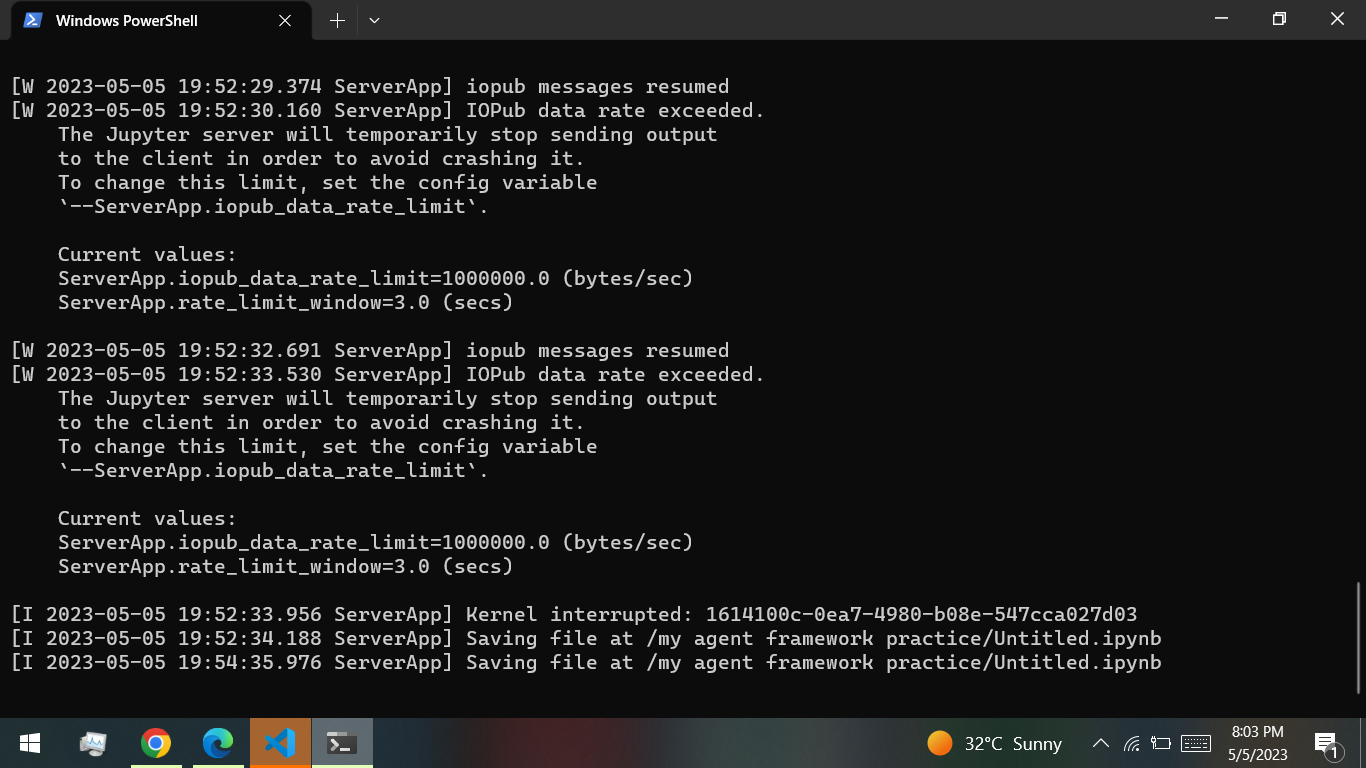
crashed my jupyter instance eekkk
Introduction
In the world of artificial intelligence, agent-based systems play a crucial role in modeling, simulating, and understanding complex environments. This article explores different agent architectures, their implementations, and visualizations of agent interactions. We started by implementing several agent architectures, and then we expanded on these implementations to create more complex multi-agent systems. Finally, we visualized the interactions between agents using network graphs.
Implementing Agent Architectures
Our journey began with the implementation of several agent architectures, including:
Belief-Desire-Intention (BDI) agents
Reactive agents
Deliberative agents
Hybrid agents (e.g., subsumption architecture)
Hierarchical Task Network (HTN) planning agents
Case-Based Reasoning (CBR) agents
These architectures offer different approaches to agent design, with varying levels of complexity and sophistication. We implemented basic versions of these agents using Python and demonstrated how they could be enhanced with modern AI language models such as GPT-3 and GPT-4.
Multi-Agent Systems and Interactions
After implementing the individual agent architectures, we focused on multi-agent systems. We created a simple multi-agent system where agents interact with each other through message-passing. This allowed us to observe the dynamics between agents, which is an essential aspect of multi-agent systems.
We then decided to explore more complex scenarios, including the Prisoner's Dilemma from the Liar Game manga. This game provided an exciting opportunity to study agent interactions in a competitive setting.
Visualizing Agent Interactions
To better understand the interactions between agents, we turned to network graphs for visualization. We used the NetworkX library in Python to create graphs representing agent interactions. By representing agents as nodes and interactions as edges in the graph, we were able to visualize the relationships and communication between agents.
Initially, we faced challenges in displaying the graph with clear and informative visuals. We iteratively improved the graph visualization, adjusting the layout, adding directional arrows to indicate message flow, and separating edges to avoid overlap. This resulted in a more intuitive and informative representation of agent interactions.
Conclusion
Throughout this journey, we implemented various agent architectures, developed multi-agent systems, and visualized agent interactions using network graphs. This exploration provided valuable insights into the design, behavior, and interactions of intelligent agents. By enhancing these agents with modern AI capabilities such as GPT-3 and GPT-4, we can create more sophisticated and powerful multi-agent systems that can help us understand and solve complex real-world problems.